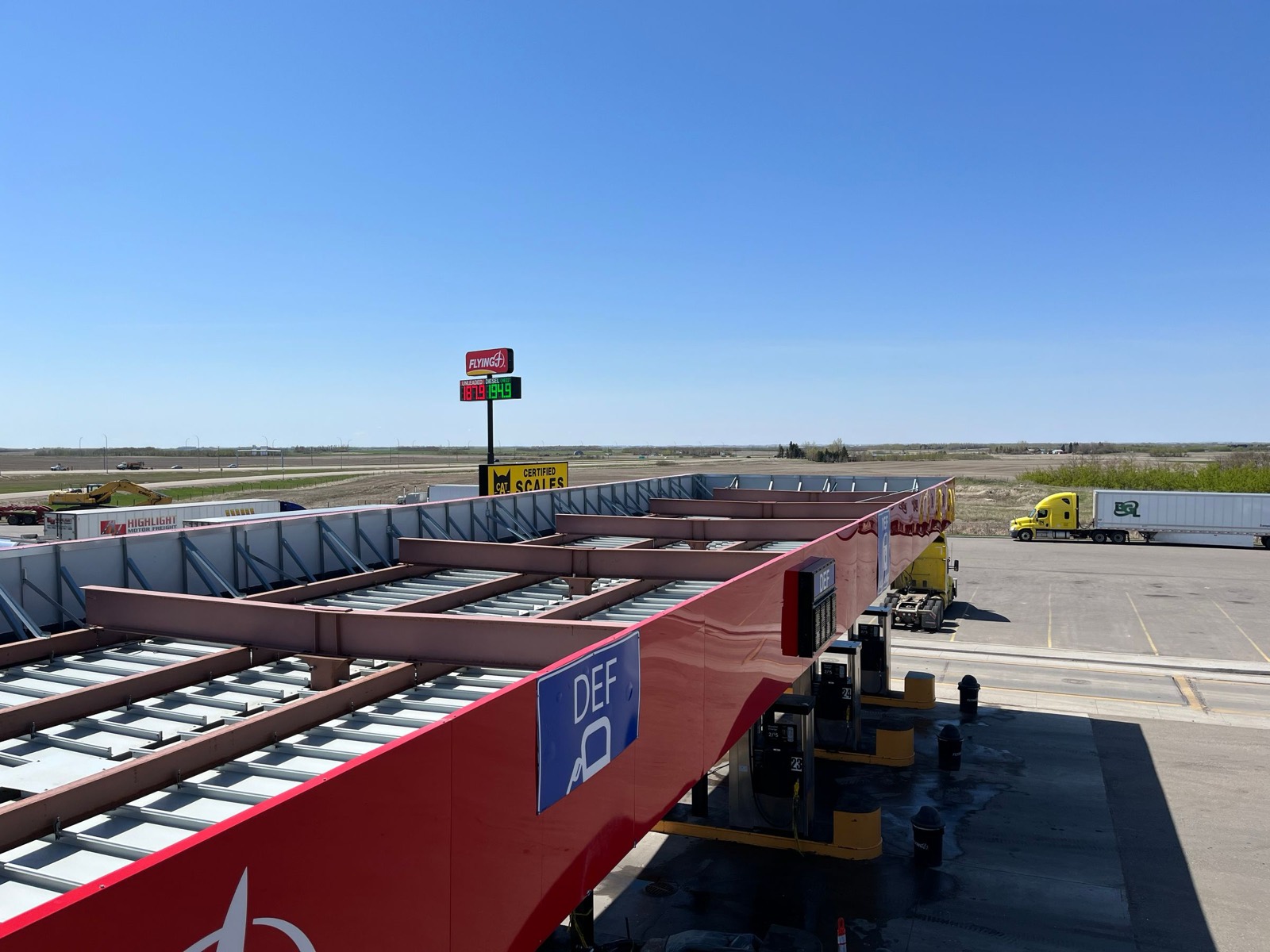
Sell a Truck Stop or Travel Center
A travel center sale is priced on diesel and gasoline throughput, inside sales, food service, truck parking, and owned real estate, and buyers underwrite each separately. Above the $5 million SBA 7(a) loan limit, the buyer pool and the debt behind it change. This page explains how these assets price, who can close one, and how to keep the sale confidential.
A travel center is not a larger gas station
A travel center sells far more fuel than a typical c-store, and much of that volume is diesel. Diesel and gasoline usually carry different margins, so gallons alone will mislead anyone pricing the asset. Two sites with similar throughput can be far apart in value depending on the fuel mix and the margin on each.
The rest of the value sits in things a c-store usually does not have: truck parking, scales, showers, DEF, repair bays, and a restaurant or quick-service brand. A buyer underwrites each of those as its own line, because each carries its own margin, its own labor, and its own capital need.
| Component | What drives it | Why it is separated |
|---|---|---|
| Diesel fuel | Gallons, margin per gallon, contract terms | High volume at a margin that differs from gasoline |
| Gasoline | Gallons and retail margin | Priced on its own volume and margin |
| Inside sales | Basket, category mix, margin | Store margin is often a large share of site profit |
| Restaurant or QSR | Franchise terms, labor, equipment | Separate operating business with its own risk |
| Truck parking and amenities | Spaces, showers, scales, DEF | Drives professional driver traffic and repeat volume |
| Real estate | Acreage, frontage, interchange position | Can be sold, leased back, or financed on its own |
How a travel center is priced
2 methods have to agree before a number is defensible. Earnings-based pricing applies a multiple to normalized earnings for the operating business. Yield-based pricing values owned real estate from rent and a cap rate. The table below shows published net-lease observations for fuel and convenience tenants, with dates and limits. It is market context, not a quote on your site.
The number that matters is the one built from your own trailing financials, your diesel and gasoline split, and what a buyer has to spend on deferred maintenance and tanks after closing. See the valuation guide for how the business and the real estate are separated.
| Observation | Published cap rate | As of | Use with care | Source |
|---|---|---|---|---|
| 7-Eleven net-lease cap rates | 3.0% to 10.1% | 2026-Q1 | The wide observed range reflects differences in location, lease term, rent, store performance, credit, and property structure. It is not a national gas-station average. | Northmarq |
| QuikTrip net-lease cap rates | 5.3% to 9.3% | 2026-Q1 | Observed tenant-level range. It is not a state average and should not be applied without reviewing the lease and site. | Northmarq |
| Sheetz net-lease cap rates | 5.1% to 6.5% | 2026-Q1 | Observed tenant-level range. It is not a state average and should not be applied without reviewing the lease and site. | Northmarq |
| Wawa net-lease cap rates | 4.5% to 6.4% | 2026-Q1 | Observed tenant-level range. It is not a state average and should not be applied without reviewing the lease and site. | Northmarq |
| 7-Eleven closed sale, Labelle, Florida | 5.25% closed cap rate | 2026-Q2 | One dated sale. It is evidence of a transaction, not a tenant-wide or state-wide benchmark. | The Boulder Group |
| Wawa closed sale, Charlottesville, Virginia | 5.16% closed cap rate | 2026-Q2 | One dated sale. It is evidence of a transaction, not a tenant-wide or state-wide benchmark. | The Boulder Group |
These tenant reports and dated sales are market context. They are not a universal gas station cap rate and do not price a specific lease or site.
Who can actually close a $10 million travel center
The SBA states that the maximum 7(a) loan is $5 million (accessed Oct 2, 2026). Many travel centers sit above that limit, so the loan program most small buyers rely on cannot carry the whole purchase. The pool narrows to buyers who bring conventional debt, other institutional financing, or cash.
That usually leaves 4 groups: multi-unit travel center operators expanding along a corridor, fuel jobbers and distributors protecting supply volume, net-lease investors buying the real estate under a lease, and private-equity-backed platforms rolling up sites. Each values the same asset differently. An operator pays for throughput and parking. A net-lease investor pays for the lease and the dirt. Running one process against all 4 is how you find the top of the market instead of the first offer.
Sale-leaseback if you want the cash without leaving
If the business is performing and you are not ready to hand it over, the real estate can be sold separately and leased back. You keep operating, keep the fuel contract, keep the staff, and convert the property into cash at a yield rather than a multiple. Owners use it to retire debt, buy additional sites, or take chips off the table before a full exit later.
It is not right for everyone. The lease you sign becomes a permanent expense that lowers the operating business value later, so the two decisions have to be modeled together.
Keeping the sale away from staff, suppliers, and competitors
A leaked travel center sale costs money. Drivers move to the next stop, good managers start interviewing, and your fuel supplier reads it as leverage on the next contract. A confidential process can be run without naming the site publicly, with financials released only after a signed NDA and buyers asked to show they can fund the deal before they see the books. The exact terms are set with you before any outreach.
If a buyer or a jobber has already approached you directly, tell us before you answer. An unsolicited offer with no competing bid is the cheapest way for a buyer to acquire a site.
What we need to give you a defensible number
Nothing here commits you to a sale, and none of it is published.
- Monthly gallons for the last 12 to 24 months, split diesel and gasoline
- Monthly inside sales, and cost of goods if you have it
- Last 2 to 3 years of tax returns or P and L statements
- Fuel supply or jobber agreement, including the expiration date
- Acreage, truck parking count, and whether scales are on site
- Restaurant or franchise agreements
- Tank age, test results, and any compliance correspondence
- Property tax statements and insurance declarations
Questions travel center owners ask
Request a confidential travel center review
Share the basics of the site. Submitting this form does not list anything publicly, and a broker follows up directly.